
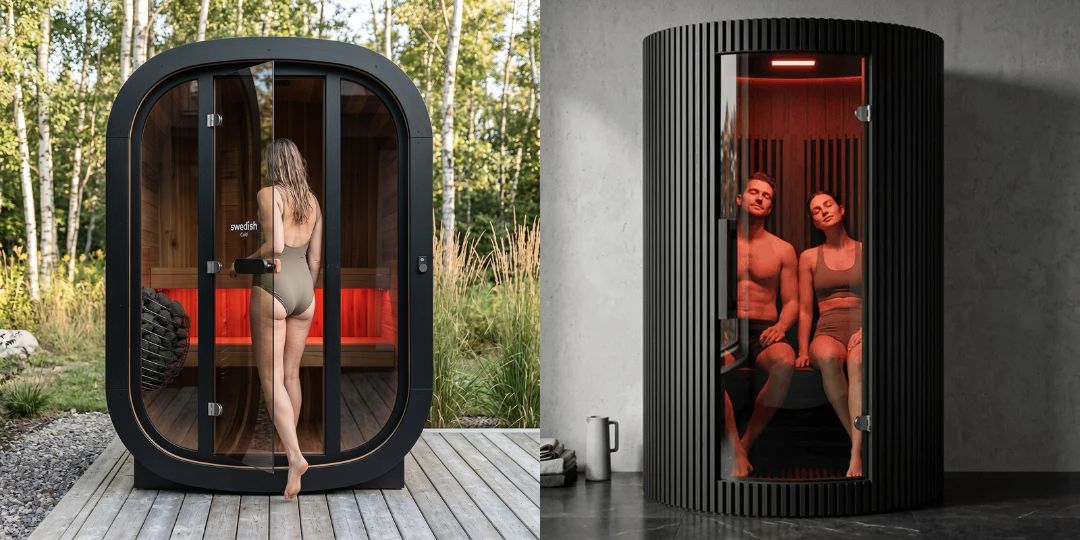
Traditional sauna or infrared sauna? That’s one of the most common questions we get. The answer depends entirely on what you’re looking for in your sauna sessions—and at the end of this article, there’s a third option that makes the question irrelevant.
Sauna bathing is more popular than ever. Research confirms its health benefits, more and more people are installing saunas in their homes, and interest in both traditional and infrared saunas is rising sharply. But once you decide to buy a sauna, the same question almost always comes up: which option should I choose?
The answer isn't that one option is better than the other. It depends on what you're looking for—and how you'll actually use your sauna. This article explains the differences in simple terms, without unnecessary complications.
What is the difference between an infrared sauna and a conventional sauna?
The fundamental distinction lies in how heat reaches the body.
A traditional sauna heats the air in the room to high temperatures—usually between 70 and 100 °C. The air warms the skin, you begin to sweat profusely, and when you pour water on the hot sauna stones, steam forms—what we call löyly. That is the heart of Nordic sauna culture and the experience that generations of Scandinavians have grown up with.
An infrared sauna works in a completely different way. Infrared panels emit radiation that heats the body directly—from within—without having to heat the air in the room nearly as much. The temperature in the cabin is lower, usually 40–60 °C, yet sweating can still be deep and effective because the heat penetrates the skin and muscles directly.
A simple analogy: a traditional sauna is like sitting in a hot oven. An infrared sauna is more like sitting in the sunshine—the heat is felt from within rather than from without.
|
FEATURE |
TRADITIONAL SAUNA |
INFRARED SAUNA |
|
Temperature |
70–100 °C |
40–60 °C |
|
Heats |
The air in the room |
The body directly, via infrared radiation |
|
Löyly (steam) |
Yes – pour water on the stones |
No |
|
Warm-up time |
30–60 minutes |
10–20 minutes |
|
Best for |
Classic sauna experience, löyly, outdoors |
Recovery, pain relief, indoors |
|
Sweating |
Heavy sweating caused by the heat in the air |
Heavier sweating at a lower temperature |
|
Siting |
Outdoors or indoors |
Indoors |
|
Energy Consumption |
Higher – more power required |
Lower – more efficient energy use |
The traditional sauna—the heat, the löyly, and the Nordic experience
There is a reason the traditional sauna has survived for thousands of years. The experience is hard to replace.
When the air in the cabin reaches 80–100 °C and you pour water on the hot sauna stones, löyly is created—the humid, intense steam that is at the heart of Nordic sauna culture. Humid air transfers heat to the body far more effectively than dry air, which means a sauna with löyly produces a deeper, more powerful physiological response. The heart rate increases, sweating intensifies, and the body mobilizes its heat reserves.
It is that feeling—the heat, the steam, the almost meditative focus on breathing—that many describe as irreplaceable. And it is that feeling that an infrared sauna, no matter how effective it is for recovery, cannot quite replicate.
A traditional sauna is right for you if you:
-
Want to experience classic Nordic sauna culture with löyly and steam?
-
High temperatures—80 to 100 °C—and the intense heat they generate
-
Want to set up the sauna outdoors in the garden and combine it with stepping out into the cold
-
Value sauna bathing as a social ritual with family or friends
-
Want to combine the sauna with an ice bath for contrast therapy?
The Infrared Sauna – Deeper Recovery at a Lower Temperature
An infrared sauna offers a different intensity. It’s ideal if you’re looking for deep muscle relaxation and recovery—without having to sit in 90-degree air to achieve it.
At 40–60 °C, the cabin is much more comfortable. You can stay inside longer, breathe more easily, and still sweat effectively—in some ways more deeply, because the infrared radiation penetrates the muscles directly rather than simply warming the skin from the outside. It is this property that makes infrared saunas particularly popular for pain relief, stiff joints, and post-workout recovery.
An infrared sauna also heats up much faster. While a traditional sauna can take 30 to 60 minutes to reach the desired temperature, an infrared sauna is ready in 10 to 20 minutes. That makes it easier to fit into your daily routine—you can start it from the app as you finish your workout and step inside when you get home.
An infrared sauna is right for you if you:
-
Want a simple indoor installation without complicated electrical or ventilation requirements?
-
Prefer a milder temperature—40 to 60 °C—that is more comfortable to sit in for longer periods
-
Are you looking for deep muscle relaxation, pain relief, or recovery after a workout?
-
Want a quick warm-up and easy everyday use via a Wi-Fi app?
-
Value: Lower energy consumption and more efficient operation
Why choose when you can have both? The Swedish Cold Hybrid Sauna
The Swedish Cold Hybrid Sauna is the answer to a question you shouldn’t have to ask. It is a freestanding indoor sauna for 4–6 people that combines a 6 kW Harvia heater with full-spectrum infrared heat in the same cabin—and it can operate using traditional heat, infrared heat, or both at once, all controlled via a touch panel or a Wi-Fi app.
But it’s not just the technology that sets it apart. Swedish Cold has designed the Hybrid Sauna to be a premium product in every detail—with features normally found only in professional spa facilities.

The advantages of a combination sauna:
-
Full flexibility. Three modes in one: traditional, infrared, or combined. You can tailor the experience to your mood, energy level, and goals.
-
No compromises. You don’t have to give up the löyly experience to enjoy the benefits of infrared therapy—or vice versa.
-
Cost-effective. A high-quality hybrid sauna costs less than buying a traditional sauna and an infrared sauna separately.
-
Space-efficient. One compartment instead of two. Ideal for home use where space is limited.
FAQ – Infrared Sauna vs. Traditional Sauna
1. How often should you use a traditional sauna?
Research shows that using a sauna 4–7 times a week provides the greatest health benefits—a 50% lower risk of cardiovascular mortality and a 66% lower risk of dementia, according to the KUOPIO study. Using a sauna two to three times a week provides noticeable benefits. Sessions lasting 15–20 minutes are optimal. Read more in our article on how often you should use a sauna based on research.
2. How often should you use an infrared sauna?
Three to five times a week is optimal. The lower temperature of an infrared sauna—40–60 °C—means the body can handle more frequent use, and sessions can be longer, lasting 20–30 minutes. Daily use is safe for most healthy adults.
3. Do infrared and traditional saunas address different issues?
Yes—and that is the crux of the entire comparison:
| Goal | Best Choice |
|---|---|
| A classic sauna experience with löyly and steam | Traditional |
| Deep muscle relaxation and pain relief | Infrared |
| Cardiovascular Health and Longevity | Traditional (most robust research) |
| Consistent daily recovery after training | Infrared |
| Stress reduction and better sleep | Both – equally good |
| Contrast therapy using an ice bath | Traditional |
| Beginner-friendly with a lower temperature | Infrared |
4. Can you use an infrared sauna every day?
Yes. Because the temperature is lower—40–60 °C compared to 80–100 °C in a traditional sauna—daily use of an infrared sauna is safe and practical for most people. This is one of its major practical advantages.
5. Should you have both types of sauna?
Ideally, yes. Traditional and infrared saunas complement each other rather than compete. They activate somewhat different physiological mechanisms and are suited to different occasions. On a Saturday evening, you might want löyly and Nordic heat. On a weekday after work, a quick 20-minute session of infrared heat is a better fit. With the Swedish Cold Hybrid Sauna, you don’t have to choose—you get both in one system.
Share:
How often should you use a sauna to see results, according to research
Infrared Sauna: Health Effects & How Often You Should Use One