
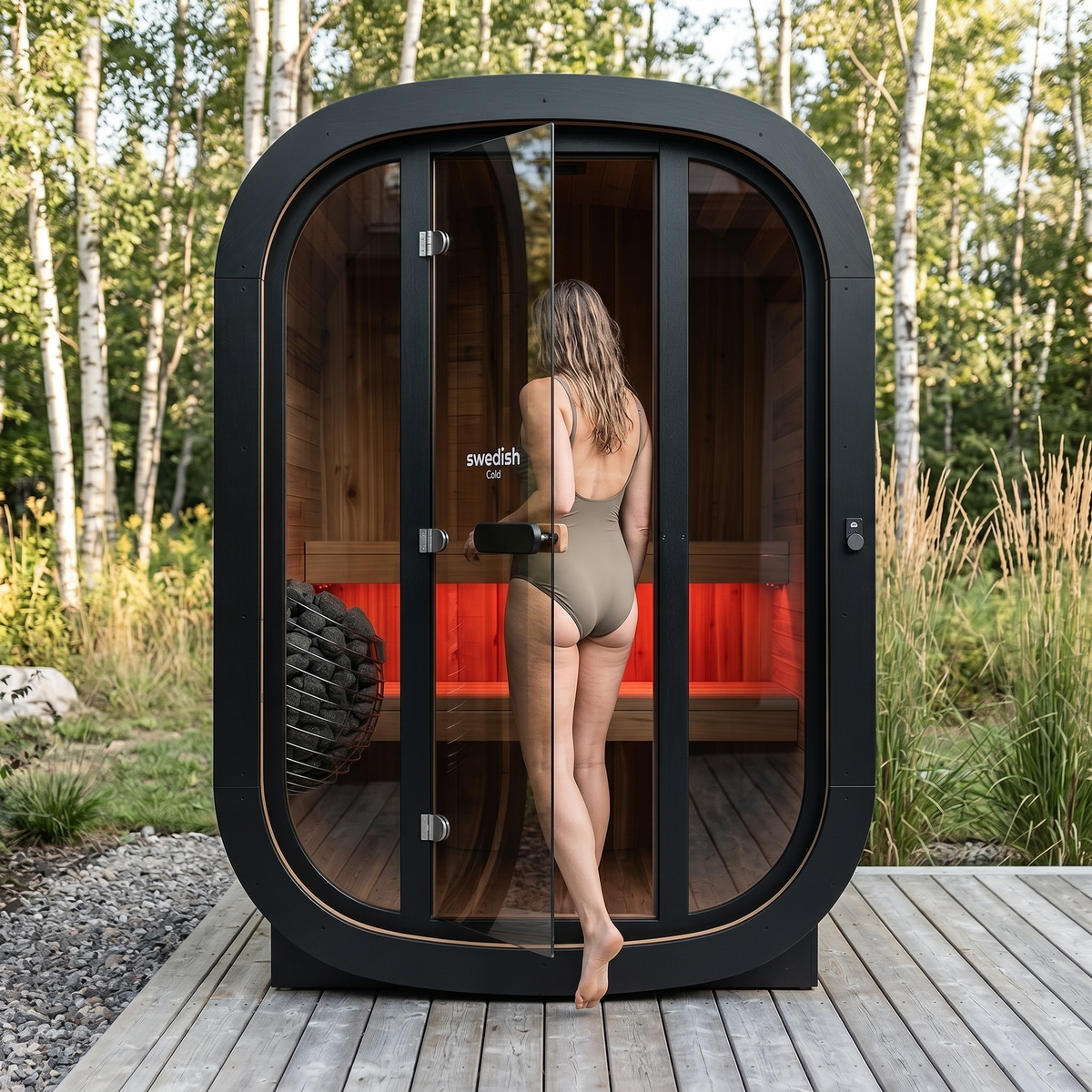
A traditional outdoor sauna can become a natural part of your garden, but a successful project starts with the location. How will the sauna be positioned? What will it be built on? Is there a suitable power source? By sorting out these questions before placing your order, you’ll receive a clearer quote and a smoother delivery.
What is a traditional outdoor sauna?
A traditional sauna uses a sauna heater to heat the sauna room and the stones. An infrared sauna, on the other hand, uses infrared heating panels. Outdoor installation is a separate consideration: the structure must be designed to withstand exposure to the elements. A standard indoor sauna does not become an outdoor sauna simply by being placed under a roof.
Start by considering the size and how you want to sit
Choose based on how many people will be using the sauna at the same time and how you plan to use the benches. The number of seats doesn’t always indicate whether someone can lie down. Therefore, ask for the interior dimensions and bench lengths, not just the exterior dimensions.
As a concrete example, according to current product information, the Private Escape is a traditional outdoor sauna for two people with external dimensions of 1,600 × 1,550 × 2,000 mm and a weight of approximately 700 kg. These dimensions describe the product itself, not the total area required for the door opening, maintenance, and safety clearances.
Subgrade, Drainage, and the Path to the Sauna
The foundation must be level and sized to accommodate the sauna’s weight and intended use. Assess the ground conditions and construction in consultation with the person preparing the site. When placing the sauna on a deck, the load-bearing capacity must be verified; a deck that appears stable is not a guarantee of its load-bearing capacity.
Plan the layout so that rainwater does not accumulate around the structure. Also, make sure to provide a safe walkway, lighting, and a place to hang a towel and cool off. Follow the model’s requirements for ventilation, spacing, and access.
Equipment and electrical systems should be planned together
The unit should be selected based on the sauna’s specifications and the manufacturer’s design. Glass surfaces and insulation can affect the power requirements. Have a qualified electrician assess the connection, power supply, and protective measures before delivery. Do not assume that a standard wall outlet is sufficient for a traditional sauna.
Also, distinguish between power and energy: a 6-kW unit running at full power for one hour uses 6 kWh. The actual energy consumption during a one-hour sauna session depends on the heating process, temperature maintenance, and on-site conditions.
Delivery: fully assembled or as a kit?
Check the width of gates, passageways, and headroom, as well as where the transport vehicle can stop. A pre-assembled sauna requires a plan for unloading and placement; a kit requires time, workspace, and assembly. A crane lift may be needed for certain projects but should be assessed based on the site.
Make sure the quote breaks down the costs for transportation, unloading, carrying into the building, assembly, electrical work, and commissioning. Also check which local regulations and any required permits apply to your specific property.
Maintenance and a quote that allows for comparison
Plan for cleaning, drying after use, and exterior wood care as described in the manual. Request a list of materials and instructions for the finish you choose.
When you contact Swedish Cold, please send photos, a simple sketch with dimensions, the desired number of seats, and information about the access route. Start with the Private Escape or compare it to the Grand Escape. If you’re also planning a cold plunge, reserve space for safe access and the plunge’s separate installation requirements.
Share:
Ice-bath tub with a cooling unit: integrated or external cooling?
Infrared Sauna at Home: A Guide to Size, Electricity, and Placement