
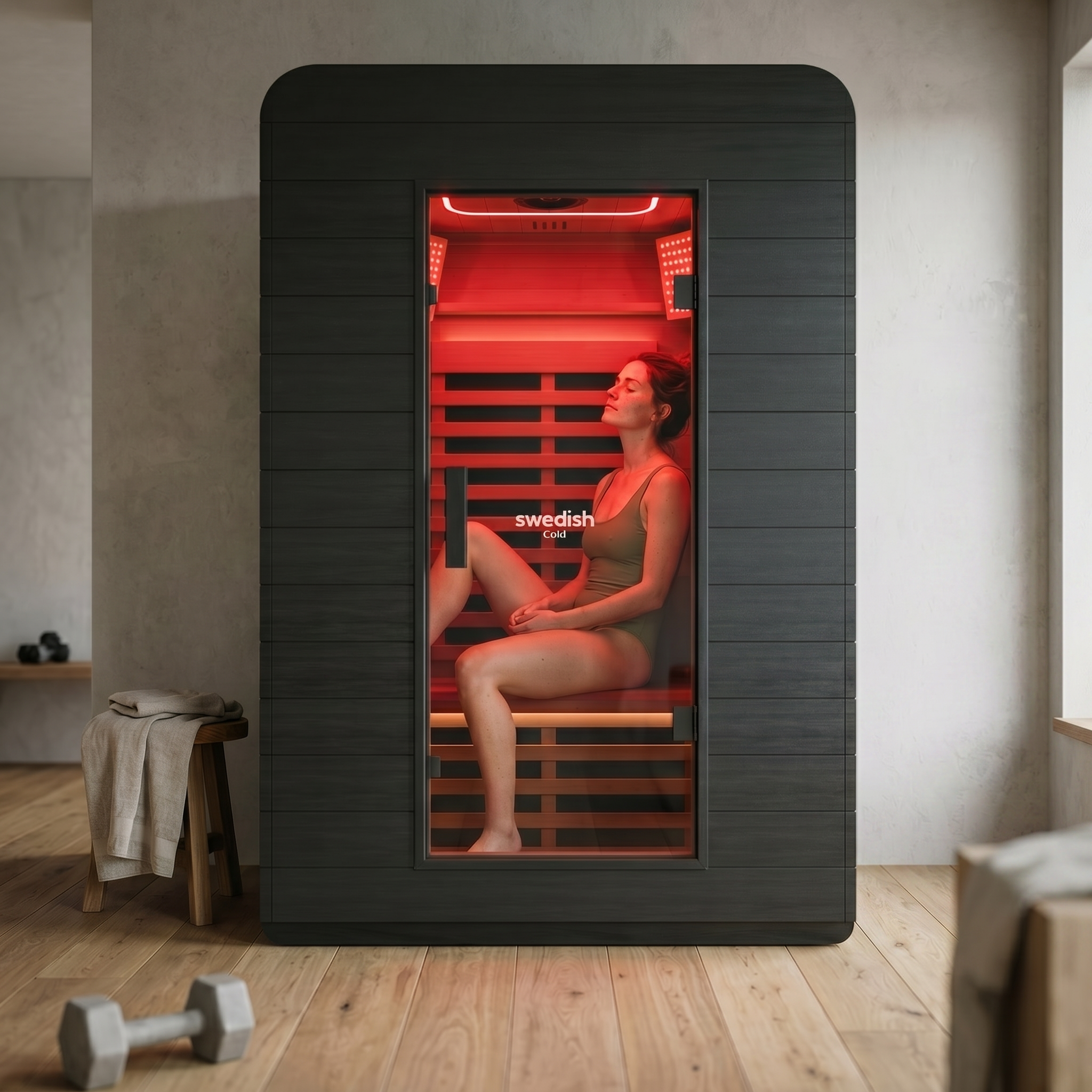
Infrared saunas are backed by more than 40 peer-reviewed studies from 2020 to 2025. But unlike traditional saunas, the effects are somewhat different—and the research points to specific health issues that infrared saunas address better than any other method.
There is a widespread misconception about infrared saunas: that they are simply a milder, more comfortable version of the traditional sauna. That is not the case. Infrared and traditional saunas activate somewhat different physiological mechanisms—andresearch shows that infrared saunas have specific benefits that a traditional sauna cannot match.
This article explains what the research actually says about the health effects of infrared saunas, how often you should use one to see results – and why consistency is the only factor that really matters.
Want to compare it to a traditional sauna and find out how often you should use one? Read our article How often you should use a sauna to see results, according to research
How an Infrared Sauna Heats the Body—and Why That Matters for Its Effects
Infrared saunas work in a fundamentally different way from traditional saunas. Instead of heating the air in the room to 80–100 °C, infrared panels emit radiation that penetrates 3–4 centimeters below the skin and heats muscle tissue directly—without the air temperature having to rise above 40–60 °C.
It is this property that gives the infrared sauna its unique characteristics. At an air temperature of 50 °C, the session is mild enough for you to sit for 30 minutes without feeling overwhelmed. At the same time, the muscles are heated more deeply and more directly than in a traditional sauna. The sweating is different—more gradual and longer lasting.
The practical consequence: an infrared sauna is easier to use on a daily basis. That is one of the most important differences from a longevity perspective, because the most significant health benefits identified in research require frequent sessions.
|
40+ Peer-reviewed studies Published 2020–2025 |
3–4 cm IR penetration depth Directly into muscle tissue |
40–60 °C Air temperature vs. 80–100 °C in a traditional sauna |
Infrared Saunas and Mental Health – The Research That Surprised the Researchers Themselves
The most significant and unexpected finding in modern infrared sauna research concerns mental health. The results are so compelling that they have changed how leading psychiatrists approach the treatment of depression and anxiety.
UCSF HEATBed Study 2024: A study at the University of California, San Francisco combined infrared heat therapy with cognitive behavioral therapy. The result: 86.2% of participants diagnosed with major depression no longer met the criteria for the diagnosis after the treatment period. That is a figure few medications can match.
Psychosomatic Medicine 2023 – cortisol: a randomized controlled trial involving 156 participants over 8 weeks. The group that used an infrared sauna three times a week for 30 minutes showed cortisol levels that were 24% lower than those of the control group. Their score on the validated Perceived Stress Scale improved by 41%—the control group improved by 15%.
Psychiatry Research 2024 – endorphins: A single infrared sauna session increased endorphin levels by 210% and serotonin levels by 18%, as measured in blood samples. The effect was observed after just one session.
|
"We are seeing an 86% treatment response in patients with major depression. That is exceptional. Heat therapy activates neurobiological pathways that we have long known about but have never had a safe and accessible way to activate consistently." Dr. Ashley Mason, UCSF – on the HEATBed Study 2024, infrared heat therapy, and depression |
The mechanism behind the effects on mental health is likely a combination of endorphin release, reduced inflammation (which is strongly linked to depression), improved sleep quality, and activation of the parasympathetic nervous system, which counteracts the chronic stress response.
Infrared Saunas and Cardiovascular Health – What Happens in the Blood Vessels
One of the strongest arguments in favor of the infrared sauna as a tool for longevity is its cardiovascular effects. A single 30-minute session produces cardiovascular responses comparable to a moderate cardio workout—the heart rate rises to 100–120 beats per minute, stroke volume increases, and the blood vessels dilate.
Frontiers in Cardiovascular Medicine 2025: A systematic review of the sauna as a treatment method for cardiovascular health and peripheral artery disease highlighted heat therapy as a “novel management approach”—particularly for patients who cannot exercise for physical reasons. Infrared saunas were specifically mentioned for their advantages at lower temperatures.
Laukkanen & Kunutsor 2024: A comprehensive review of passive heat therapy confirmed that regular sauna use—including infrared saunas—improves vascular function, reduces arterial stiffness, lowers blood pressure, and reduces the risk of cardiovascular disease, stroke, and dementia.
The cardiovascular benefits of the infrared sauna are particularly significant for one specific group: those who, for various reasons, are unable to exercise. An infrared sauna provides exercise-like cardiovascular stimulation without placing mechanical stress on the joints and muscles.
Infrared Saunas and Inflammation – CRP, Rheumatic Conditions, and Chronic Pain
Inflammation is a common factor underlying most chronic diseases—cardiovascular disease, diabetes, depression, autoimmune conditions, and some cancers. It is also the area in which research on infrared saunas is most focused and most clinically relevant.
Reduction in CRP: Studies show a 28–30% reduction in C-reactive protein (CRP)—one of the most important markers of systemic inflammation—after 3 weeks of regular infrared sauna use. That is a clinically significant reduction.
Rheumatoid arthritis and ankylosing spondylitis: A study at Saxion University of Applied Sciences treated 34 patients (17 with rheumatoid arthritis, 17 with ankylosing spondylitis) with eight 30-minute infrared sauna sessions at 55 °C over a 4-week period. Patients reported a significant reduction in pain, stiffness, and fatigue during the treatment period.
One important point to note: the research shows that anti-inflammatory effects take time. One or two sessions produce no measurable change in inflammatory markers. It is consistent, regular use over several weeks that yields measurable results—just as with exercise.
Infrared Saunas and Muscle Recovery – A Deeper Effect at a Lower Temperature
This is the effect most people notice first: the body feels different afterward. Muscles that were stiff are now relaxed. The tension that had been there all day is gone. That’s not a placebo effect—it’s physiology.
Infrared radiation penetrates 3–4 centimeters into muscle tissue and increases local blood flow. This accelerates the removal of lactic acid and metabolic waste products from the muscle, reduces swelling, and dampens the inflammatory response that causes delayed-onset muscle soreness (DOMS).
Compared to a traditional sauna—which is also effective for recovery—the infrared sauna has the advantage of being ready to use immediately. You don’t have to wait 45–60 minutes for the cabin to heat up. You start it from the app, step inside after 10–20 minutes, and can enjoy a session right after your workout without having to reschedule your entire evening.
-
DOMS is measurably reduced after even a single session performed immediately after training
-
Blood flow increases locally in the treated muscle tissue due to IR penetration
-
Sleep quality improves – deep sleep increases with regular use of an infrared sauna
-
Cortisol levels drop – the baseline level of the stress hormone drops by 24% with 3 sessions per week over 8 weeks
How often should you use an infrared sauna? A guide to frequency based on research
The short answer: more is better, and consistency is key. But here are the specific recommendations broken down by goal:
|
GOAL |
FREQUENCY |
SESSION |
WHAT THE RESEARCH SAYS |
|
General Well-Being |
2–3 times a week |
20–30 min |
A clear improvement in stress levels and sleep within 2–3 weeks |
|
Muscle Recovery |
3–5 times a week |
20–30 min |
Reduces CRP by 28–30% after 3 weeks of regular use |
|
Mental Health |
3 times a week |
30 min |
A 24% reduction in cortisol levels and a 41% improvement on a stress scale (8-week study, 156 participants) |
|
Cardiovascular Health |
4–7 times a week |
20–30 min |
Lower blood pressure, reduced arterial stiffness, improved endothelial function |
|
Longevity & Optimal |
4–7 times a week |
20–30 min |
Strongest effect on every parameter—a linear relationship with no ceiling effect |
One important difference from the traditional sauna: the lower temperature of an infrared sauna makes daily use genuinely feasible for most healthy adults. You don’t need to rest as long between sessions. That makes it easier to achieve the frequency that delivers the strongest effects.
Building Your Infrared Sauna Routine – From Beginner to Optimal Protocol
The most important advice is to start slowly. Your body needs to get used to IR heat just as it does to any other form of exercise. Here is a gradual progression:
|
BUILD YOUR INFRARED SAUNA ROUTINE |
||
|
Weeks 1–2 |
2–3 times a week · 15 min · 40–50 °C |
Let your body get used to IR heat. Notice how the sweating differs from that in a traditional sauna—it’s deeper and more gradual. |
|
Weeks 3–4 |
3–4 times a week · 20 min · 50–55 °C |
Increase gradually. You should start noticing improved sleep quality and lower stress levels after each session. |
|
Months 2–3 |
4–5 times a week · 25–30 min · 55–60 °C |
The optimal range for muscle recovery and anti-inflammatory effects. A reduction in CRP is visible after 3 weeks. |
|
Month 3+ |
4–7 times a week · 30 min · 55–60 °C |
The Longevity Protocol. Cardiovascular adaptations and hormonal changes accumulate. Consistency is key. |
Always listen to your body. Dizziness, nausea, or extreme fatigue after a session are signs that you should lower the temperature or shorten the session. Drink water before and after.
Infrared or traditional sauna—do you have to choose?

That's the wrong question. The research clearly shows that they address partly different problems.
The traditional sauna is best for:
-
Cardiovascular exercise and longevity data (the KUOPIO study's 50% lower cardiac mortality)
-
The löyly experience and Nordic sauna culture
-
Outdoor treatment and contrast therapy with an ice bath
The infrared sauna is ideal for:
-
Mental health and depression treatment (86% remission rate, UCSF 2024)
-
Daily muscle recovery and pain relief
-
Stress Reduction and Cortisol Regulation
-
Indoor installation and daily accessibility
The optimal solution is both. The Swedish Cold Hybrid Sauna combines a traditional 6 kW Harvia heater with full-spectrum infrared heat in the same cabin—you choose the mode from the touch panel depending on what you need that day. One system. No compromises.
Read more about the Hybrid Sauna: Swedish Cold Hybrid Sauna – traditional and infrared in one
Scientific sources:
3. Psychiatry Research (2024) – Single infrared sauna session: endorphins +210%, serotonin +18%
Share:
Infrared Sauna vs. Traditional Sauna – What's the Difference, and Which One Is Right for You?
How much water should you drink after a sauna?