
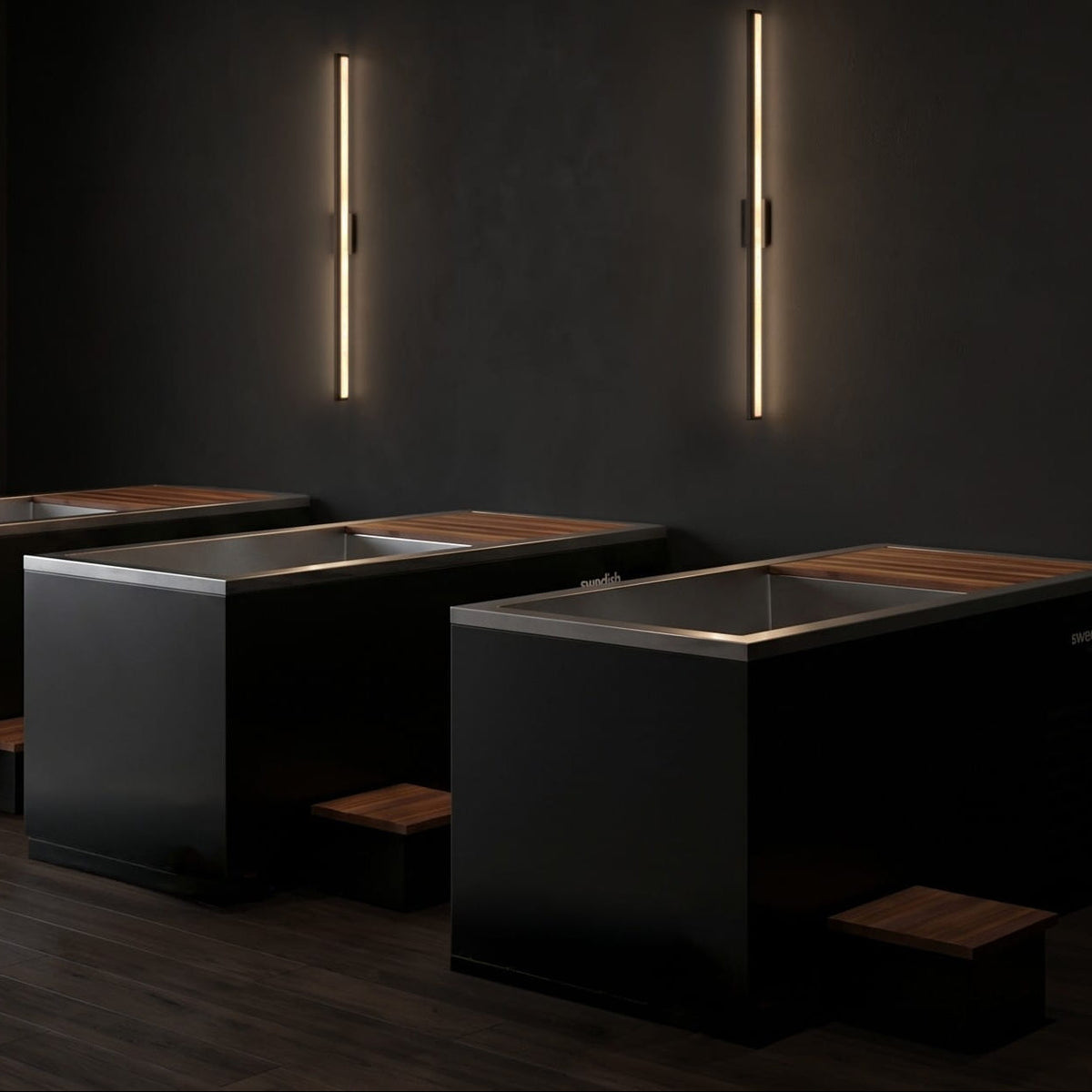
An ice bath tub with a cooling unit allows you to keep the water cold without having to add ice before every bath. However, the location of the cooling unit affects how much space the system takes up, how the installation is planned, and how you access the parts during maintenance. Here, we compare integrated and external cooling systems for those planning to set up a cold bath at home or in a business.
What is the difference between the systems?
With integrated cooling, the cooling system is part of the hot tub’s design. With external cooling, a separate unit is placed next to or near the tub and connected according to the manufacturer’s instructions. There are two ways to set up the system; the placement of the cooling unit alone does not determine quality, noise level, or energy consumption.
| Comparing | Integrated cooling | External cooling unit |
|---|---|---|
| Space | The technology is integrated into the product's design. Service space is still required. | Be sure to allow space for the tank, the unit, and the connections. |
| Planning | Check the airflow, electrical connections, and access to the technical compartment. | Also check the hose routing, connections, and the permitted distance. |
| Service | The technical section must be accessible after installation. | A separate unit may be easier to access, depending on its location. |
Cooling capacity is more than just the lowest temperature
Ask how the system works in the environment where you plan to use it. A bath in a cool room and a bath on a sunny patio have different conditions. Ask about the system’s capacity at the relevant air temperature and water volume, as well as how long it takes to cool down. For gyms and spas, the number of users and the breaks between baths must also be taken into account.
A low temperature value in a specification does not indicate how quickly a full bath cools down. Nor does it indicate what temperature is appropriate for an individual user.
Filtration, Noise, and Daily Maintenance
Cooling does not replace water maintenance. Check how circulation, filtration, cleaning, and water changes should be handled. A filter traps particles but does not, in and of itself, mean that water maintenance can be skipped. Ask for instructions tailored to residential or commercial use.
If the ice bath is to be placed near a seating area or a bedroom, ask how the noise was measured: at what distance and in what operating mode? Also make sure that the unit’s ventilation is not blocked by a wall or built-in structure.
Compare the total cost
Take into account shipping, installation, any electrical preparations, filters, water treatment, and service. For electricity, measured kilowatt-hours over a representative 24-hour period are more useful than just the rated power. Consumption is influenced by factors such as weather, insulation, the lid, temperature settings, and usage.
Five Questions to Ask Your Supplier
- Is the model approved for the intended location and use?
- What are the requirements for electricity, ventilation, and drainage?
- How much does the pool weigh with water and users?
- What maintenance and replacement parts are needed?
- What is included in delivery, setup, warranty, and support?
Compare a Complete Solution
See Generation 5 and the latest product information. Please feel free to send your measurements, photos of the installation site, and intended use to Swedish Cold for advice. For more information to help you make your decision, please see our buying guide for home cold baths.
This guide is intended as a planning reference. Always follow the manual for the selected model when installing, maintaining, and using the unit.
Share:
Cold Plunge Pools for Gyms, Hotels, and Spas: A Guide to Capacity and Installation
Traditional Outdoor Sauna: Plan Your Sauna in the Garden