
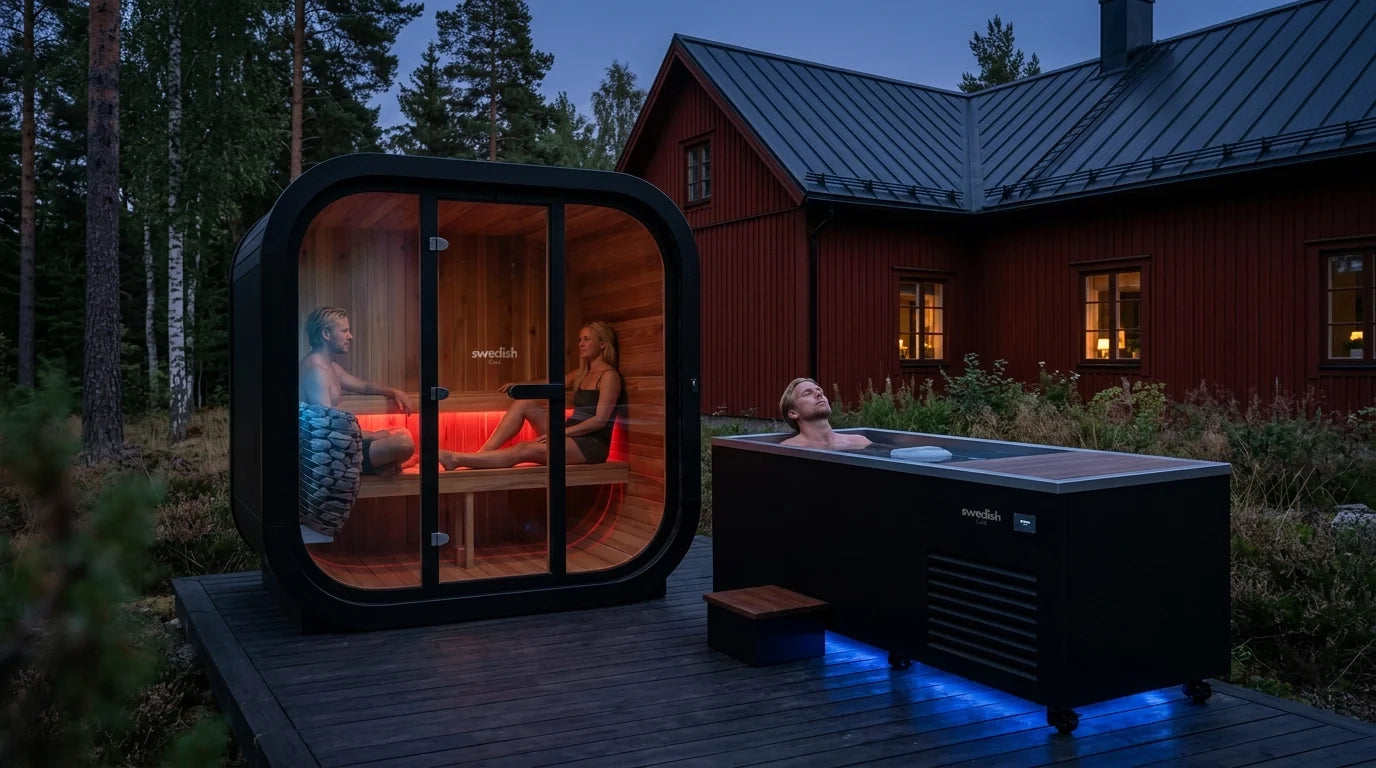
A cold bath involves immersing your body in water that’s below 15 degrees, usually for two to five minutes. The effects have been well documented: metabolism quadruples during the bath, norepinephrine levels rise by 530 percent, mood improves measurably after a single bath, and regular bathers have fewer sick days. Here are the figures, source by source, and an overview of the different types of cold baths to choose from.
Short answer
Cold baths involve controlled exposure to cold water below 15 degrees. The most clearly documented effects include increased alertness and improved mood, lower perceived stress in the hours following the bath, faster recovery after intense exercise, and a metabolic shift that occurs with regular exposure. To experience these benefits in your daily life, you need a solution that maintains the temperature without requiring you to carry ice—which, in practice, means a cold bath with a built-in or external cooling unit.
Cold Baths by the Numbers
Eleven minutes a week is equal to 0.1 percent of the hours in a week. That is the entire effort behind the figures above.
What counts as a cold bath?
Cold bathing refers to bathing in water that is colder than 15 degrees. In the research literature, 15 degrees is used as the threshold, and this is the definition on which the studies below are based. If the water temperature is close to zero, it is more commonly referred to as an ice bath; in English, the term “cold plunge” is used to describe the same thing.
The difference between the terms, then, is a matter of degree, not method. The Swedish cold-bath tradition—with its cold-bath houses, watch, and dock—involves the same physiology as a temperature-controlled tub on the patio. The difference lies in how easy it is to do it all over again tomorrow.
Most people who cold-bathe regularly start at temperatures between 2 and 8 degrees. Beginners are better off starting at around 10 to 12 degrees and gradually working their way down over a few weeks. We go over temperatures and durations in more detail in the guide on how cold a cold bath should be.
What happens in your body when you step into cold water?
The first thing that happens is a reflex. The blood vessels in the skin constrict, breathing becomes deep and rapid, the heart rate increases, and the nervous system shifts into high gear. After about thirty seconds, breathing slows down, and what remains is a steady, alert feeling.
Beneath the surface, something more measurable is happening. In a classic study at Charles University in Prague, young men sat in water for an hour at three different temperatures, and the researchers measured everything from metabolism to hormone levels. The difference between lukewarm and cold water is dramatic.
Increase in metabolic rate during a one-hour swim
Compared with rest at room temperature. Šrámek et al., European Journal of Applied Physiology, 2000.
The same study measured the hormonal response at 14 degrees. Norepinephrine, the body’s wakefulness signal, increased more than sixfold, and levels remained elevated long after the bath was over. Adrenaline, on the other hand, did not change at all, which is worth noting: the cold affects a different system than a pure stress response.
Hormonal response after one hour in 14-degree water
Change in plasma concentration. Šrámek et al., 2000.
It’s this hormonal response that explains why so many people describe the same effects afterward: mental clarity, energy, and a noticeably better mood that lasts for hours. If you’d like to read more about the process itself, there’s an overview in the article “What Happens in the Body During an Ice Bath.”
Health Benefits of Cold Baths According to Research
Cold-water immersion is one of the most extensively studied recovery methods available. Below are the effects that have the strongest support in published research, with a source cited for each claim.
Focus, energy, and a better mood
A single swim is enough to measurably improve one’s mood. In a controlled study at the University of Chichester, 42 people swam for up to 20 minutes in 13.6-degree seawater, while 22 people served as the control group. Mood was assessed using the Profile of Mood States, a well-established questionnaire in which a lower score indicates a better mood.
Mood Before and After a Cold Bath
Total POMS score. A lower score indicates a better mood. Kelly and Bird, Lifestyle Medicine, 2022.
The 15-point improvement, compared with the control group’s 2-point improvement, was seen across all subscales. The greatest changes were observed in mental clarity and stress level.
Improvement by subscale after one bath
A favorable change in scores. Kelly and Bird, 2022.
Over time, the results point in the same direction. Finnish researchers followed 36 people through four months of winter swimming from October to January, with 23 people serving as a control group. Stress and fatigue gradually decreased, and after four months, the swimmers described themselves as more energetic, active, and alert than the control group (Huttunen et al., International Journal of Circumpolar Health, 2004).
Lower stress levels in the hours following a bath
The largest systematic review to date in this field examined eleven randomized studies involving a total of 3,177 participants, conducted in water between 7 and 15 degrees. The most evident effect was a significant reduction in stress levels twelve hours after the bath, with an effect size of 1.00 and a confidence interval that does not cross zero. The review also noted that sleep quality, quality of life, and reduced sick leave showed positive trends (Cain et al., PLOS ONE, 2025).
It’s worth noting how the effect changes over time. The cold invigorates the body in the moment and calms it in the hours that follow. Many people therefore take a bath in the morning or early afternoon and notice the difference in the evening.
Faster recovery after exercise
This is where the largest amount of data is available. A network meta-analysis combined the results of 57 studies involving 1,220 participants and ranked four methods against each other following intense exercise. The ranking was performed using SUCRA, a metric in which 100 percent indicates that the method is the best in all comparisons.
| What Is Measured | Best Method | SUCRA |
|---|---|---|
| Creatine kinase, muscle stress in the blood | Contrast bath, alternating between hot and cold | 79,9 % |
| Muscle soreness | Cold Treatment | 88,3 % |
| Renewed Hope | Cold Treatment | 83,7 % |
Source: BMC Musculoskeletal Disorders, 2024.
In practical terms, this means two things. Cold is what relieves muscle soreness and gets your legs working again the fastest, while alternating between hot and cold is what best normalizes your blood values. So if you have both a sauna and a cold bath, you get the best of both worlds.
Fewer sick days
In one of the largest randomized studies on cold exposure, 3,018 Dutch participants were randomly assigned to end their shower with cold water for 30, 60, or 90 seconds every day for one month, or to a control group that did not use cold water. The difference in sick leave was clear and statistically significant.
Days of sick leave during the study period
Indexed against the control group. Buijze et al., PLOS ONE, 2016.
The effect was the same regardless of whether the participants stood in the cold for 30, 60, or 90 seconds. This suggests that it is the regularity that makes the difference, not the duration (Buijze et al., PLOS ONE, 2016).
It has also been shown more directly that cold exposure can affect the immune response. In a study published in PNAS, twelve healthy individuals underwent ten days of training in breathing techniques, meditation, and cold exposure, with twelve untrained individuals serving as the control group. The trained group released more adrenaline, had higher levels of the anti-inflammatory signaling molecule IL-10, lower levels of the pro-inflammatory molecules TNF-alpha, IL-6, and IL-8, and reported milder symptoms when their immune systems were subsequently stimulated under controlled conditions (Kox et al., PNAS, 2014).
Metabolism and Adaptation to Cold
Over the course of a year, Danish researcher Susanna Søberg measured how the bodies of experienced winter bathers—who had combined cold baths with saunas two to three times a week for at least two years—adapted. The bathers had lower resting body temperatures and increased their own heat production significantly more than the control group when exposed to cold. Their heart rate and blood pressure rose less, which is the hallmark of cold tolerance. The study concludes that winter swimming promotes both heat and cold adaptation, and that the method is of interest as a way to increase energy expenditure (Søberg et al., Cell Reports Medicine, 2021).
We have summarized her work separately in the article on Susanna Søberg and the science behind ice baths, and we discuss metabolism in more detail in the article on the effects of cold baths on metabolism.
A Summary of the Current State of Research
The ten publications on which this article is based, including study design, number of participants, and main findings.
| Study | Year | Design and Participants | Key Findings |
|---|---|---|---|
| Šrámek et al. | 2000 | Experimental, young men, one-hour baths at 32, 20, and 14 degrees | Metabolism +350%, norepinephrine +530%, dopamine +250% at 14 degrees |
| Huttunen et al. | 2004 | Controlled study, 36 winter swimmers and 23 controls, four months | Less stress and fatigue, more energy and alertness |
| Kox et al. | 2014 | Randomized, 12 in the training group and 12 in the control group, 10 days of training | Higher levels of adrenaline and IL-10; lower levels of TNF-alpha, IL-6, and IL-8 |
| Laukkanen et al. | 2015 | Cohort, 2,315 men, 20.7 years of follow-up | A 63% lower risk of sudden cardiac death with 4 to 7 sauna sessions per week |
| Buijze et al. | 2016 | Randomized controlled trial, 3,018 participants, 30 days | 29% fewer sick days |
| Hussain and Cohen | 2018 | Systematic review, 40 studies, 3,855 participants | Regular sauna use has health-promoting potential |
| Søberg et al. | 2021 | Controlled group of experienced winter swimmers versus control group, one year | Increased endogenous heat production and clear cold tolerance |
| Kelly and Bird | 2022 | Monitored: 42 swimmers and 22 monitors; 13.6 degrees | A 15-point improvement in mood compared with 2 in the control group |
| BMC Musculoskeletal Disorders | 2024 | Network meta-analysis, 57 studies, 1,220 participants | Contrast baths are best for creatine kinase; cold therapy is best for muscle soreness |
| Cain et al. | 2025 | Systematic review and meta-analysis, 11 studies, 3,177 participants | Reduced stress levels 12 hours after the bath |
How cold, for how long, and how often does it have an effect?
Søberg’s measurements of winter swimmers showed an average of about eleven minutes in cold water per week, spread out over two to three sessions. That figure has become the benchmark, and it is strikingly low. Four two-minute sessions are more than enough.
The second piece of advice from the same study is to end with a cold bath when doing contrast bathing. This forces the body to warm itself up instead of having the heat provided for it, which is the whole point of the metabolic effect.
| temperature | Fits | Time per bath | Frequency | Minutes per week |
|---|---|---|---|---|
| 10 to 15 degrees | The First Few Weeks | 2 to 5 minutes | 2 to 3 times | 4 to 15 |
| 5 to 10 degrees | Regular swimmer | 2 to 4 minutes | 3 to 4 times | 6 to 16 |
| 0 to 5 degrees | Experienced swimmer | 1 to 3 minutes | 3 to 4 times | 3 to 12 |
Consistency is what makes the difference, not the temperature. Two calm minutes four times a week are more effective than a single heroic effort while awake. If you want to learn more, there’s a separate guide on how long you should stay in an ice bath.
Contrast Therapy: Sauna and Cold Bath Combined
The Swedish and Finnish traditions have always combined the two, and research supports this combination. The effects of sauna bathing have been studied in the Finnish KIHD data set, in which 2,315 men aged 42 to 60 were followed for just over twenty years. The relationship between sauna frequency and risk is strikingly stepwise.
Risk of Sudden Cardiac Death by Sauna Frequency
Risk ratio, with one sauna session per week as the reference. A lower bar indicates a lower risk. Laukkanen et al., JAMA Internal Medicine, 2015.
The difference between the highest and lowest groups corresponds to a 63 percent lower risk, and the researchers observed the same pattern for coronary artery disease, cardiovascular disease, and all-cause mortality (Laukkanen et al., JAMA Internal Medicine, 2015). A systematic review of 40 clinical studies involving a total of 3,855 participants concluded that regular sauna use has health-promoting potential (Hussain and Cohen, 2018).
A simple routine to follow when you have access to both a sauna and a cold bath:
| Step | Sauna | Cold bath | Rest between |
|---|---|---|---|
| Round 1 | 10 to 15 minutes | 1 to 2 minutes | 3 to 5 minutes |
| Round 2 | 10 to 15 minutes | 2 to 3 minutes | 3 to 5 minutes |
| Round 3 | 10 to 15 minutes | 2 to 3 minutes | Finish Cold |
The order matters, and we'll go over it in the article on whether to take a sauna or an ice bath first.
What types of cold baths are there?
The market is divided along four lines: how the water is cooled, what material the tub is made of, how you sit in it, and how the water is kept clean. Here are the categories and what sets them apart.
Cold Bath Without a Chiller
The simplest option is an insulated tub or a wooden barrel that you fill with cold water and cool down with ice. It’s the most affordable way to get started and works great as a first test to see if cold bathing is right for you. During the winter months, the outdoor temperature often helps cool the water down a bit. This category includes everything from inflatable portable tubs to solid oak barrels.
Cold bath with built-in or external cooling unit
A cooling unit, often called a chiller, keeps the water at a selected temperature around the clock, regardless of the season. For example, you can set the temperature to 4 degrees in the app, and the water will be at 4 degrees when you get home—whether it’s July or January. The unit is either built into the tub or installed as a separate unit next to it.
This is the type that turns cold baths into a routine rather than a project, since the entire logistical aspect is eliminated. It’s also the category where the differences between models are greatest—especially in terms of cooling capacity, how low the unit can cool the water, and how quickly it restores the temperature after a bath.
Combined cold and hot bath
Some tubs feature both cooling and heating in the same system and cover the entire range from ice baths to hot baths. The same tub can then be used for post-workout recovery and for a relaxing hot bath in the evening, which is convenient when space is limited to a balcony or a bathroom.
Materials: wood, stainless steel, and composite
The choice of materials determines both the look and how much maintenance the bath requires.
| material | Expressions | Hygiene | Care | Common in |
|---|---|---|---|---|
| Spruce and Thermowood | Classic Nordic | Porous surface | Recurring Surface Treatment | Simpler barrels |
| Oak | Massive and heavy | Porous surface | Recurring Surface Treatment | Traditional tubs |
| Red cedar | Warm and Scandinavian | Naturally moisture-resistant | Low, age gracefully | Outer shell for premium tubs |
| Stainless steel | Sleek and modern | Smooth, does not absorb moisture | Minimal | Containers for daily and heavy-duty use |
| Composite and Acrylic | Lightweight and malleable | Smooth surface | Low | Affordable TV Series |
Horizontal vat or vertical barrel
A horizontal tub allows you to stretch out your legs and lower your shoulders while leaning back slightly. It is the most common type, and many people find it the most comfortable for lying still for a few minutes.
A freestanding, vertical tub allows you to fully submerge your body while taking up significantly less floor space. It features a classic Nordic design and is particularly well-suited for spaces with limited floor area or when the tub is intended to serve as a piece of furniture.
Water Treatment: Filters, Ozone, and UV
A cold-water bath that remains set up year-round needs to keep the water clean between uses. Three techniques are commonly used, often in combination.
| Technology | What it does | Effective against | Chemicals |
|---|---|---|---|
| Particle filter | Mechanically captures particles as the water circulates | Hair, skin flakes, dirt | No |
| Ozone purification | Oxidizes organic matter in the water | Bacteria | No |
| UV sterilization | Irradiates the water as it passes through the lamp | Microorganisms | No |
The more steps in the process, the longer the intervals between water changes, and the better the pool can handle a high number of users per day. For home use, one water change per month is usually sufficient, since the filtration system operates automatically in between.
Overview of the Types
| Type of cold bath | Temperature Control | All Year Round | Best suited for |
|---|---|---|---|
| Barrel or vat without a unit | Ice and Outdoor Temperature | Season | Try it out |
| Tub with cooling unit | Selected temperature around the clock | Yes | Daily Routine |
| Combined cold and hot bath | Cooling and heating in the same tank | Yes | Limited space, contrast bath |
| Vertical barrel | External cooling unit | Yes | Small floor space, classic look |
| Tank for the facility | High cooling capacity, multi-stage purification | Yes | Gym, spa, hotel, clinic |
Swedish Cold's Cold Baths: Three Types for Different Needs
Our product line covers three of the categories listed above. All products are plug-and-play, plug into a standard electrical outlet, and are controlled via a touch panel or app.
Generation 4S: Combined Cold and Hot Bath
The Generation 4S covers the entire range from 3 to 40 degrees in a single tub. Cooling, heating, and filtration are integrated, with no external units. The tub is constructed of industrial-grade 316 stainless steel and can withstand Nordic outdoor climates down to minus 10 degrees with the water circulating. Triple filtration with ozone purification keeps the water clean and chemical-free, and the insulated lid maintains the temperature between soaks. At 175 centimeters long and holding approximately 500 liters, it is the compact model for the patio, balcony, or bathroom.
Nordic Tub: Standing Cold Bath Made of Cedar
Nordic Tub is a vertical design that allows for full-body immersion in a small floor space. The outer shell is made of solid red cedar, which is naturally resistant to moisture and temperature fluctuations, and the interior is made of 304 stainless steel for hygiene and durability. An external high-performance cooling unit keeps the water at a stable 3 degrees year-round, and a sturdy staircase for safe entry is included. The volume is approximately 450 liters.
Generation 5: Professional cold bath for daily, heavy-duty use
Generation 5 is designed for homes and facilities where the pool is used every day. The cooling system maintains a temperature of 0 to 8 degrees Celsius with automatic ice formation and self-circulating water, and has a cooling capacity of 1.5 horsepower. The water is purified through a four-stage system featuring a particle filter, ozone purification, and UV sterilization; for commercial use, a five-stage version is available with an additional hair particle filter and a reinforced pump system. The tub holds 568 liters, is constructed of stainless steel with red cedar accents, and comes with an insulated protective cover, external steps, and integrated LED lighting.
Complete Specification Comparison
| Property | Generation 4S | Nordic Tub | Generation 5 |
|---|---|---|---|
| Design | Horizontal tank | Vertical cylinder | Horizontal tank |
| temperature | 3 to 40 degrees | Down to 3 degrees | 0 to 8 degrees |
| Warm-up | Yes, integrated | No | No |
| Water volume | about 500 liters | approx. 450 liters | 568 liters |
| Weight (empty) | about 100 kg | 120 kg | 150 kg |
| material | 316 stainless steel | Red cedar on the outside, 304 stainless steel on the inside | Stainless steel with red cedar |
| Cooling system | Integrated | External unit | Integrated, 1.5 HP |
| Water treatment | Triple filter with ozone | Closed-loop circulation | Four-stage ozone and UV system, optional five-stage system |
| Current | 220 V, 50 Hz | Standard electrical outlet | 220 to 230 V, 12 A |
| Energy consumption | approx. 0.75 kW/h | By unit | about 3 to 10 kWh per day |
| Noise Level | Max 62 dB with active cooling | By unit | By unit |
| Steering | Touchscreen and app | App | Touchscreen and app |
| Included | Insulated cover, underwater LED | Stairs | Insulated lid, steps, LED lighting |
| Outdoor use | Yes, down to minus 10 degrees | Yes | Yes |
| Certification | CE | CE | CE |
| Warranty | 1 year, up to 5 | 1 year, up to 5 | 1 year, up to 5 |
Our entire product line is available in our cold-water tubs and ice baths.
Operation and Maintenance
A temperature-controlled cold bath uses electricity to keep the water cold and to circulate it through the filtration system. Multiply the kWh figure by your own electricity rate to calculate the cost for your specific system.
| Post | Interval | Comment |
|---|---|---|
| Water Change | About once a month | Applies to private use with active treatment |
| Filter Replacement | About once a month | 26 filters are equivalent to about one year of personal use |
| Filter Replacement, Facility | More frequently | 104 filters are equivalent to about one year of professional use |
| Electricity Consumption, Generation 5 | 3 to 10 kWh per day | Equivalent to approximately 90 to 300 kWh per month |
| Night Mode via Timer | Optional | The water is cold again within an hour of the start at the latest |
How to Choose the Right Type of Cold Bath
Start by considering how often you plan to take a bath and where you'll put the tub. The rest will follow from there.
- You want to bathe year-round without having to deal with ice. Choose a tub with a cooling unit. That’s the single most important factor in maintaining your routine once the novelty has worn off.
- You have limited space. A freestanding tub like the Nordic Tub allows for full immersion while taking up the least possible floor space, and the Generation 4S is compact enough for most balconies and bathrooms.
- You want both cold and hot water in the same tub. The Generation 4S covers a range from 3 to 40 degrees and makes contrast baths possible without having to install two separate systems.
- The hot tub should remain outdoors year-round. Make sure the structure is built to withstand the Nordic climate, with the water circulating even at sub-zero temperatures.
- Several people will be swimming every day. Prioritize cooling capacity and multi-stage filtration. Generation 5 is designed for this scenario, and a professional five-stage upgrade is available for facilities.
- You want that classic wood look. Red cedar on the outside and stainless steel on the inside give it that look without compromising on hygiene.
If you run a gym, spa, hotel, or clinic, we’ve put together a guide to ice baths and wellness for businesses, and we walk you through the practical details in our article on how a facility can offer ice baths and wellness services.
A sauna as a complement to a cold bath
If you want to set up a full contrast therapy session at home, you’ll also need a heat source. The product line is divided into two types. An infrared sauna heats the body directly with radiation instead of heating the air, providing a deep heat bath at a lower temperature and with a shorter warm-up time. A traditional sauna provides dry heat at 80 to 90 degrees Celsius using a genuine heater and sauna stones, along with the option to pour water on the stones.
| Model | Type | People | Heat source | Location |
|---|---|---|---|---|
| Sanctuary Solo | Infrared | 1 | Full-spectrum infrared | Indoors |
| Sanctuary Duo | Infrared | 2 | Full-spectrum infrared | Indoors |
| Ultimate Lux | Infrared with a red light panel | 1 to 2 | Full-spectrum infrared | Indoors |
| Hybrid Sauna | Combined | 4 to 6 | 6 kW unit and infrared | Indoors |
| Heritage | Traditional | 2 to 3 | Unit with sauna stones | Indoors |
| Private Escape | Traditional | 2 | 4.5 kW generator set | Outdoors |
| Grand Escape | Traditional | 4 | 8 kW generator set | Outdoors |
The infrared models are constructed of Canadian hemlock, while the outdoor saunas are made of carbonized white pine with a waterproof and corrosion-resistant roof. See the selection under “Infrared Sauna” and “Traditional Sauna,” and read about the differences between the heating methods in the article comparing infrared saunas to traditional saunas.
How to Get Started with Cold Baths at Home
- Start with a higher temperature than you think. Set it to 10 to 12 degrees for the first few weeks, and lower it by one degree at a time when it feels comfortable.
- Keep it short. Two minutes is more than enough to start with. A total of eleven minutes a week is the benchmark recommended by research.
- Exhale slowly. The first thirty seconds are the most intense part. A long exhalation helps your breathing settle down more quickly.
- Take a bath early in the day. The cool water immediately boosts alertness and calms the body in the evening.
- Let your body warm up on its own afterward. Get dressed and move around gently instead of jumping right into a hot shower—that way, you'll get the full metabolic benefit.
- Take a contrast bath when you have access to a sauna. Start with a hot bath, then finish with a cold one.
- Swim regularly. Three to four short sessions a week are what make a difference over time.
If you are pregnant, have a heart or vascular condition, or are taking medication, check with your doctor before you begin. A daily routine is described in the article on taking ice baths at home and creating a wellness routine.
Frequently Asked Questions About Cold Baths
What are the benefits of cold baths?
Research consistently links cold baths to increased alertness and improved mood, lower perceived stress in the hours following the bath, faster recovery and less muscle soreness after intense exercise, fewer sick days, and a metabolic shift that occurs with regular exposure. See the research overview above for details on each study.
What counts as a cold bath?
Swimming in water that is colder than 15 degrees. If the water temperature is close to zero, the term “ice bath” is usually used. The method is the same.
What happens in the body when you take a cold bath?
The blood vessels in the skin constrict, breathing becomes deeper, and the heart rate increases. At the same time, large amounts of norepinephrine and dopamine are released, and the body begins to generate its own heat. In the study from Charles University, metabolism increased by 350 percent, norepinephrine by 530 percent, and dopamine by 250 percent after a one-hour bath in 14-degree water.
How often should you take a cold bath?
According to research on winter swimmers, the recommended guideline is about 11 minutes in cold water per week, spread out over two to three sessions. Most people who swim regularly do three to four sessions a week, each lasting two to four minutes.
Is it good to take a cold bath every day?
Many experienced swimmers swim every day and enjoy it. Research shows that benefits can be achieved with just two to three sessions a week, so daily swimming is more about establishing a routine than about it being necessary to get results. Listen to your body and keep your sessions short.
Does it matter how long you serve?
Less than many people think. In the study of 3,018 participants, the effect on sick leave was the same regardless of whether the participants stood in the cold for 30, 60, or 90 seconds. It’s the regularity that matters.
Should you take a sauna before or after a cold bath?
For most people, the natural order is to start with the sauna and then take a cold bath, and ending with the cold bath enhances the metabolic effect. If you want to fall asleep easily afterward, you can end with the heat instead.
Does a cold bath at home need a cooling unit?
If you want to swim year-round, yes. A cooling unit maintains the selected temperature around the clock, regardless of the season, and eliminates the entire process of dealing with ice—which, in practice, is what determines whether the system will hold up over time.
How often does the water need to be changed?
In a multi-stage filtration tank, it is normally sufficient to change the water and filters about once a month for residential use. The filtration process runs automatically in between. In commercial operations with many users per day, more powerful filtration systems and more frequent maintenance intervals are used.
How much electricity does a cold bath use?
It depends on the model, the ambient temperature, and how low you set the temperature. Generation 5 is rated at 3 to 10 kWh per day. With the timer function, the system can remain off overnight, and the water is cold again within an hour of startup at most.
Sources
- Šrámek P et al. Human physiological responses to immersion in water of different temperatures. European Journal of Applied Physiology, 2000.
- Huttunen P et al. Winter swimming improves general well-being. International Journal of Circumpolar Health, 2004.
- Kox M et al. Voluntary activation of the sympathetic nervous system and attenuation of the innate immune response in humans. PNAS, 2014.
- Laukkanen T et al. Association between sauna bathing and fatal cardiovascular and all-cause mortality events. JAMA Internal Medicine, 2015.
- Buijze GA et al. The effect of cold showers on health and work: a randomized controlled trial. PLOS ONE, 2016.
- Hussain J, Cohen M. Clinical effects of regular dry sauna use: a systematic review. Evidence-Based Complementary and Alternative Medicine, 2018.
- Søberg S et al. Altered brown fat thermoregulation and enhanced cold-induced thermogenesis in young, healthy men who swim in winter. Cell Reports Medicine, 2021.
- Kelly JS, Bird EL. Improved mood following a single immersion in cold water. Lifestyle Medicine, 2022.
- The Effects of Hydrotherapy and Cryotherapy on Recovery from Acute Post-Exercise-Induced Muscle Damage: A Network Meta-Analysis. BMC Musculoskeletal Disorders, 2024.
- Cain T et al. Effects of cold-water immersion on health and well-being: a systematic review and meta-analysis. PLOS ONE, 2025.
Ready to create your own routine?
A cold plunge pool with built-in cooling maintains the selected temperature around the clock, year-round, and that is the single biggest difference between a routine that sticks and one that fizzles out. Check out our cold plunge pools, compare them with our sauna selection, or contact us and we’ll help you choose the right model for your space. We’d be happy to schedule a viewing at one of our showrooms or a digital tour.
Share:
How much water should you drink after a sauna? -
Commercial-Grade Ice Bath: A Guide for Gyms, Hotels, and Spas